
Reverse Grip Chin Up
Reverse Grip Chin Up is an intermediate bodyweight exercise for the latissimus dorsi (lats). Most lifters train it for 3 to 4 sets of 5 to 10 reps.
A compound upper-body pulling exercise performed on a pull-up bar using a supinated (underhand) close grip. The movement starts from a full hang with the body controlled and stable, followed by pulling the chest upward until the chin clears the bar. The elbows stay close to the torso as the lats and arms work together through a full range of motion, with a slow and controlled lowering phase back to the starting position.
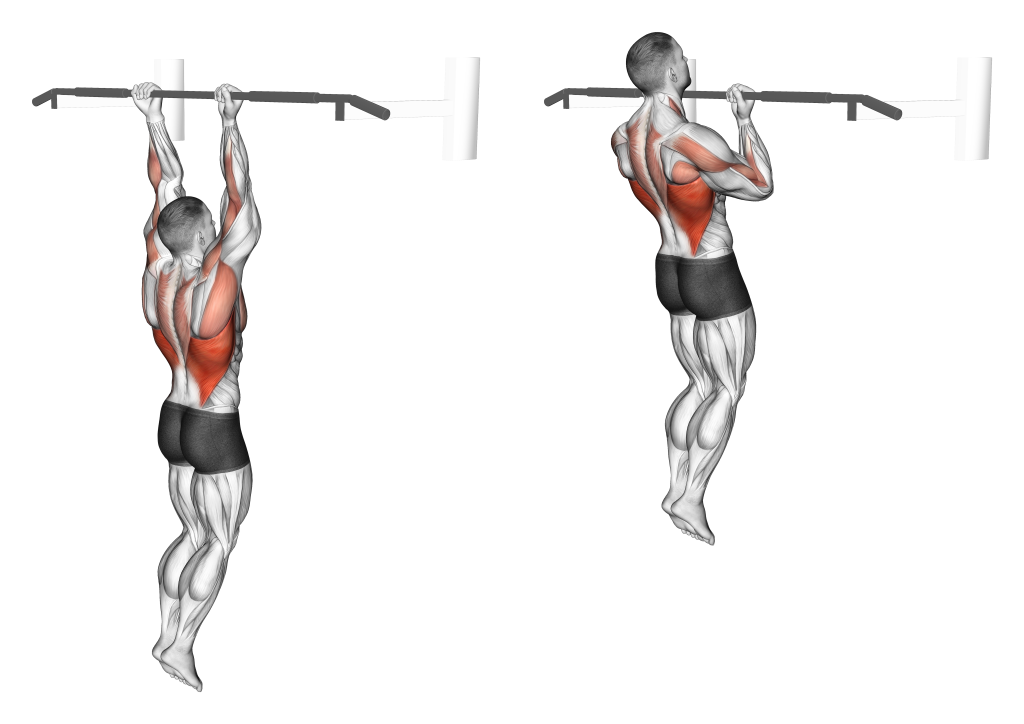
How to Do the Reverse Grip Chin Up
- Grab the bar with palms facing you, hands about shoulder-width apart or slightly narrower.
- Hang with arms fully straight, legs together, and core braced to stop swinging.
- Pull the shoulder blades down and back to start the movement before the elbows bend.
- Drive the elbows down toward the ribs while pulling your chest toward the bar.
- Continue pulling until your chin clears the bar without craning the neck or tilting the head back.
- Lower slowly over two to three seconds to a full dead hang and repeat.
Common Mistakes
- Half reps: Stopping short at the bottom or top cuts the range and the strength gains. Go from full hang to chin over the bar.
- Kipping and swinging: Using momentum reduces lat and biceps work. Brace the core and keep the legs still.
- Reaching with the chin: Craning the neck to clear the bar fakes the rep. Pull the chest up instead.
Programming Tips
Program 3 to 4 sets of 5 to 10 reps as a main vertical pull early in a back or pull session. Chin ups build lat width and biceps size together and are one of the best measures of relative upper-body strength.
If you cannot do 5 reps, use band assistance or slow negatives of five seconds each. Once you can do 10 clean reps, add 2.5 to 5 kg with a belt or dumbbell between the feet. The most common fault is cutting range short at the bottom; fix it by pausing in a full hang for one second before every rep.
Common Questions
Are chin ups or pull ups better?
Chin ups use more biceps and are usually easier, while pull ups emphasise the lats and upper back more. Both build a strong back.
What muscles do chin ups work?
Chin ups work the lats and biceps most, with the mid back, rear delts, and core assisting. The underhand grip increases biceps work.
How do I get my first chin up?
Practise slow negatives, band-assisted reps, and rows two to three times a week. Most people get their first rep within a few weeks of consistent training.
Related back exercises
Other ways to train the same muscle, with whatever equipment you have.
Programming the Reverse Grip Chin Up
- How to deadlift for the hinge and bar path.
- Best back workout to build the full session.
- How many sets per workout to pick your weekly volume.
- How many reps to build muscle for choosing a rep range.
- How long to rest between sets for strength vs size.
Track This Exercise in the App
Log your reverse grip chin up sets in 1RM.fit and watch your estimated 1RM update automatically as you get stronger.