
Run
Run is a beginner bodyweight exercise for the primary: quadriceps secondary: calves.
Steady-state running for cardiovascular conditioning. Keep a relaxed posture, land midfoot, and breathe rhythmically.
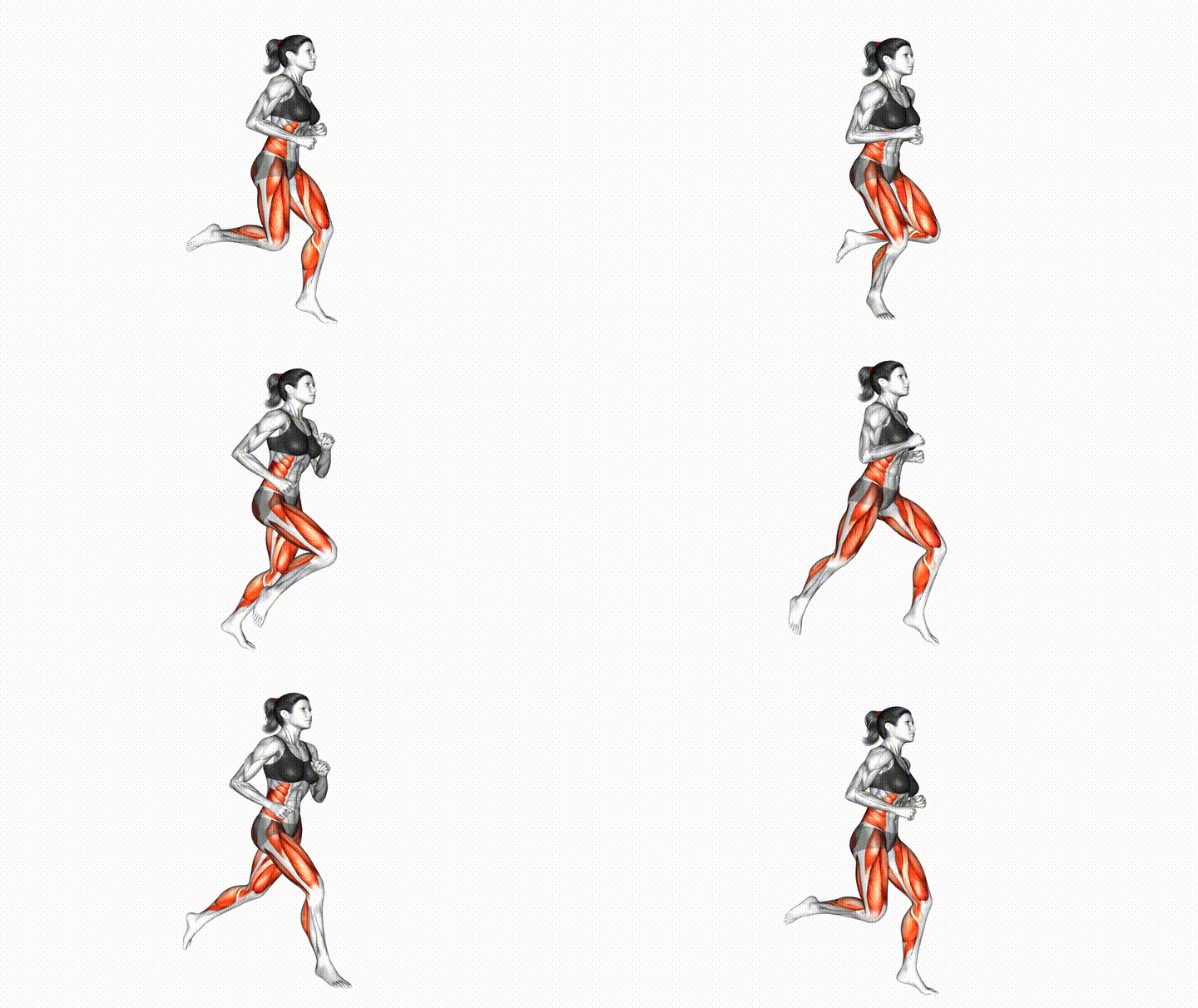
How to Do the Run
- Start with five minutes of brisk walking or very easy jogging to warm the calves and hips.
- Run tall with a slight forward lean from the ankles, eyes on the horizon and shoulders relaxed.
- Land with the foot under the hips on the mid-foot rather than reaching out with the heel.
- Keep the cadence quick and light, around 170 to 180 steps per minute, with short ground contact.
- Swing the arms forward and back from the shoulders with elbows bent about 90 degrees.
- Breathe rhythmically, settling into a pace you can hold for the planned time or interval.
- Finish with three to five minutes of easy jogging and walking to bring the heart rate down.
Common Mistakes
- Overstriding with the heel: Reaching the foot far ahead brakes every step and loads the shins and knees. Shorten the stride and increase cadence so the foot lands under the body.
- Starting too fast: New runners sprint the first few minutes and blow up. Run slowly enough to speak in sentences for the bulk of your mileage.
- Increasing mileage too quickly: Jumping volume faster than tendons adapt causes shin splints and knee pain. Add no more than about 10 percent per week.
- Tense upper body: Shrugged shoulders and clenched fists waste energy. Drop the shoulders and hold the hands as if carrying an egg.
Programming Tips
For intervals program 4 to 8 sets of 60 to 120 seconds at a hard pace with equal jogging recovery, and for steady state run 20 to 45 minutes at an easy, conversational effort. Place runs on non-lifting days or after upper-body sessions so leg strength work is not compromised, with two to four runs per week depending on goals.
Set up with cushioned running shoes and a route or track where you can hold a steady pace. Beginners should start with alternating 1 to 2 minutes of running and 1 minute of walking for 20 minutes, extending the running blocks each week until 20 to 30 minutes continuous. The most common fault is overstriding on the heel, which causes shin and knee pain; shorten the stride and raise cadence toward 170 to 180 steps per minute.
Common Questions
What muscles does running work?
Running works the calves, quadriceps, hamstrings and glutes for propulsion, with the hip flexors and core stabilising each stride. The heart and lungs are the main beneficiaries over time.
How often should I run if I also lift weights?
Two to three runs per week is enough to build and keep aerobic fitness without hurting strength gains. Keep most runs easy and separate hard runs from heavy leg days by at least a day.
Is running bad for your knees?
No, long-term studies show recreational runners have no higher rate of knee arthritis than non-runners. Knee pain usually comes from sudden mileage jumps, overstriding or weak hips, all of which are fixable.
Is it better to run or use the elliptical?
Running builds more bone strength and transfers to sport better, while the elliptical spares the joints. If you can run pain-free, run; if impact is the issue, the elliptical gives similar heart benefits.
Related cardio exercises
Other ways to train the same muscle, with whatever equipment you have.
Track This Exercise in the App
Log your run sets in 1RM.fit and watch your estimated 1RM update automatically as you get stronger.