
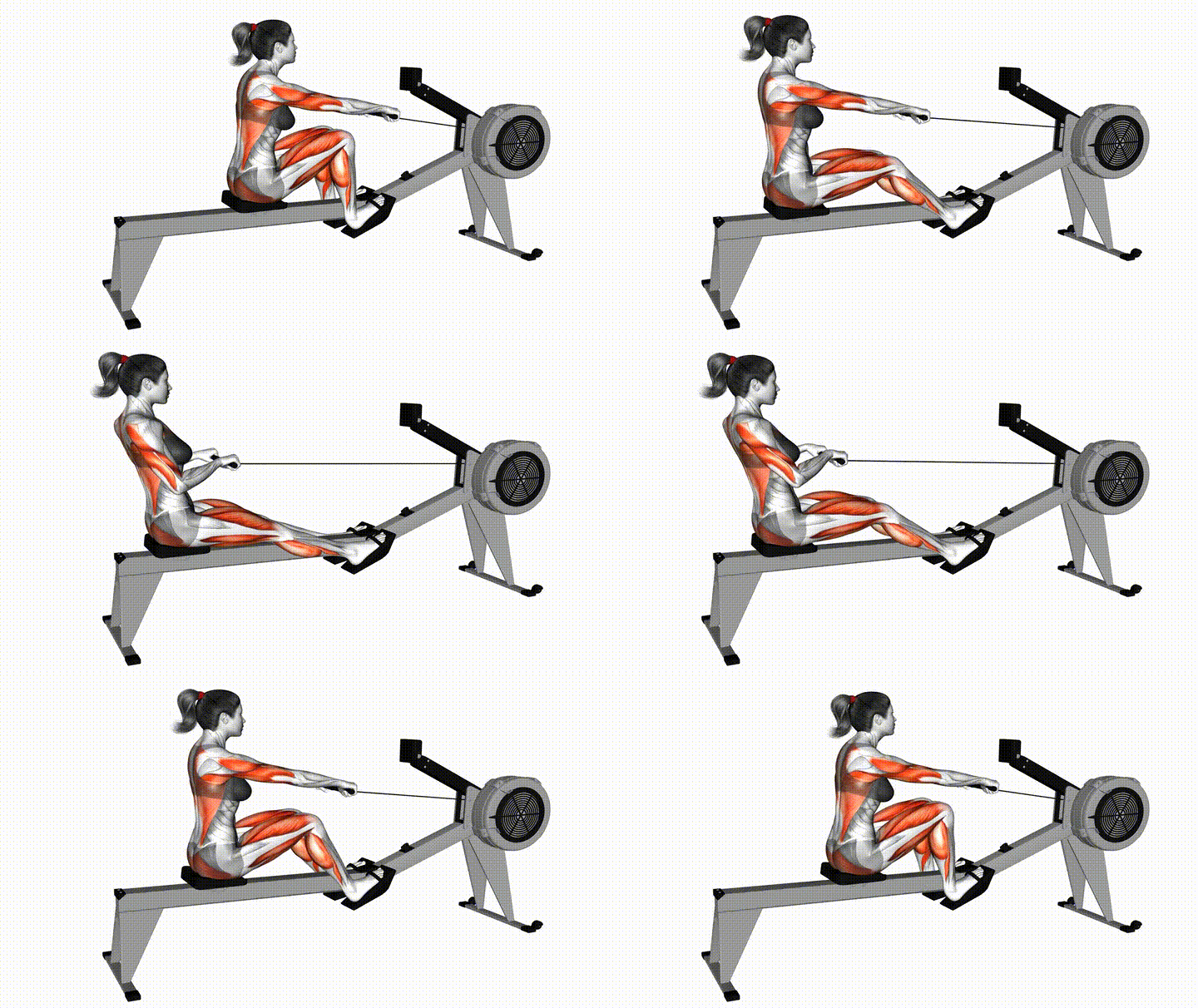
How to Do the Rowing
- Strap the feet in with the strap over the ball of the foot and set the damper around 3 to 5.
- Grip the handle overhand, slide forward until the shins are vertical, with arms straight and torso leaning slightly forward.
- Drive the legs down hard while keeping the arms straight and the back angle unchanged.
- As the legs near straight, swing the torso back to about an 11 o'clock lean.
- Finish by pulling the handle to the lower ribs with the elbows driving past the body.
- Return by extending the arms first, then hinging the torso forward, then bending the knees.
- Repeat in a steady rhythm of legs, body, arms on the drive and arms, body, legs on the recovery.
Common Mistakes
- Pulling with the arms first: Bending the elbows at the catch wastes the legs, the strongest part of the stroke. Keep the arms straight until the legs are almost extended.
- Damper set too high: A damper of 10 feels heavy but slows the flywheel and makes each stroke a grind. Set it between 3 and 5 for a rowing-like feel.
- Rounding the lower back: Slumping at the catch and yanking loads the lumbar spine. Hinge from the hips with a tall chest and brace before each drive.
- Rushing the recovery: Flying back to the catch doubles the stroke rate without adding power. Take the recovery about twice as long as the drive.
Programming Tips
For intervals program 4 to 8 sets of 60 to 120 seconds hard with equal easy rowing between, and for steady state row 20 to 30 minutes at a conversational pace around 20 to 24 strokes per minute. Rowing works as a whole-body warm-up, a conditioning finisher after lifting, or a stand-alone cardio session on rest days.
Set the damper at 3 to 5, strap in over the ball of the foot and learn the legs, body, arms sequence at an easy pace first. Beginners should start with 10 to 15 minutes at a comfortable pace of roughly 2:30 to 3:00 per 500 metres, adding five minutes per week or shaving a few seconds off the split each session. The most common fault is pulling with the arms before the legs have driven; fix it by rowing with straight arms only for a few strokes each warm-up.
Common Questions
What muscles does rowing work?
Rowing works the quadriceps, glutes and hamstrings in the drive, the spinal erectors and core in the swing, and the lats, rhomboids and biceps in the finish. Roughly 60 percent of the power comes from the legs.
Is rowing better than running for fat loss?
Both burn similar calories at matched effort, but rowing has no impact and works the upper body too. Choose rowing if joints are a concern, running if you want bone loading and sport transfer.
What damper setting should I use on the rowing machine?
Set the damper between 3 and 5, which feels like a racing boat and lets you keep a smooth, fast flywheel. Higher settings do not mean a harder workout, just a slower, heavier stroke.
How long should I row each session?
Beginners do well with 10 to 15 minutes building to 20 to 30 minutes of steady rowing, or 15 to 20 minutes of intervals. Two to four sessions per week is plenty alongside lifting.
Related cardio exercises
Other ways to train the same muscle, with whatever equipment you have.
Track This Exercise in the App
Log your rowing sets in 1RM.fit and watch your estimated 1RM update automatically as you get stronger.