
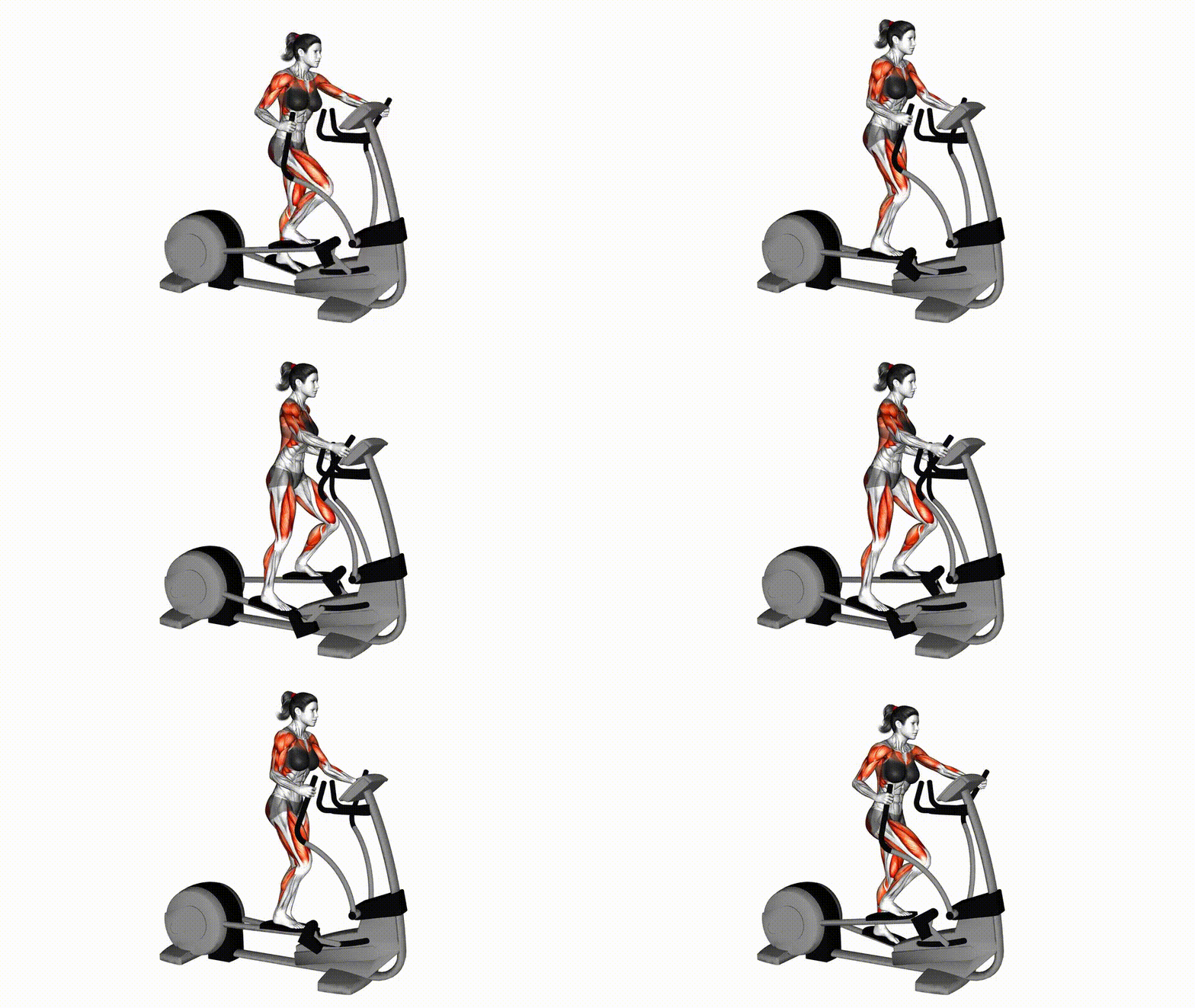
How to Do the Elliptical Cross Trainer
- Step onto the pedals, grab the moving handles and set a light resistance and flat incline to start.
- Stand tall with hips under the shoulders, feet flat on the pedals and the gaze forward.
- Push the pedals in a smooth oval, driving down through the mid-foot and heel rather than the toes.
- Pull one handle toward the chest as the other pushes away, matching the leg rhythm.
- Build to your target resistance and stride rate over the first two to three minutes.
- Hold the pace with relaxed shoulders and a quiet upper body, breathing steadily through the effort.
- Finish with two to three minutes of easy striding before stepping off.
Common Mistakes
- Hanging on the handles: Leaning on the static bars unloads the legs and drops the effort. Use the moving handles or let the arms swing freely so the legs do the work.
- Heels lifting off pedals: Pedalling on the toes burns out the calves and can numb the feet. Keep the heels down and press through the whole foot.
- Resistance set too low: Spinning with no load lets momentum carry the pedals and the heart rate never rises. Add resistance until each stride needs a real push.
Programming Tips
For intervals program 6 to 10 sets of 60 to 90 seconds hard with equal easy recovery, or for steady state ride 20 to 40 minutes at a conversational pace. Use it as a warm-up before lower-body lifting, as a low-impact cardio session on rest days, or as the conditioning finisher after a training session.
Set the resistance so a stride needs effort but the cadence stays smooth, and keep the incline low until the pattern feels natural. Start with 15 to 20 minutes of steady work at a heart rate around 60 to 70 percent of your maximum, then add 5 minutes per week or raise resistance one level every two weeks. The most common fault is leaning on the handles with the shoulders hunched; stand tall and let the legs drive the machine.
Common Questions
What muscles does the elliptical work?
It works the quadriceps, glutes, hamstrings and calves, with the chest, back and arms contributing when you use the moving handles. Raising the incline shifts more work onto the glutes and hamstrings.
Is the elliptical as good as running?
For heart and lung fitness it is close when the effort is matched, but running builds more bone density and sport-specific strength. The elliptical wins when impact needs to be low.
How long should I use the elliptical to lose fat?
Aim for 150 to 300 minutes per week at a moderate effort spread across several sessions. Fat loss still depends mostly on diet, so treat the elliptical as support rather than the whole plan.
Should I use the elliptical forward or backward?
Forward striding should be the default because it is the most natural pattern. Short backward blocks of a few minutes shift emphasis toward the quads and can add variety.
Related cardio exercises
Other ways to train the same muscle, with whatever equipment you have.
Track This Exercise in the App
Log your elliptical cross trainer sets in 1RM.fit and watch your estimated 1RM update automatically as you get stronger.